

A talent mobility strategy is a structured, skills-based approach to moving employees within an organization through promotions, lateral moves, or projects to align workforce capabilities with business needs, improve retention, and support employee growth. It helps organizations reduce hiring costs and build a more agile, future-ready workforce.
According to LinkedIn’s 2025 Workplace Learning Report, 44% of organizations with internal mobility programs consider them a key career-building practice, contributing to higher employee retention.
In this guide, you’ll learn the 6 key steps to build a talent mobility strategy, along with the different types of mobility and the benefits it delivers to both organizations and employees.
Types of Talent Mobility
Talent mobility can take several forms depending on business needs, employee aspirations, and workforce structure. The most common types include:
- Vertical Mobility: Promotions or upward career moves where employees take on roles with greater responsibility, leadership scope, or decision-making authority.
- Lateral Mobility: Movement across teams, departments, or functions at a similar level. This helps employees build broader business knowledge while enabling organizations to fill roles internally.
- Project-Based Mobility: Short-term assignments, cross-functional initiatives, or strategic projects that allow employees to develop new skills without a permanent role change.
- Geographic Mobility: Movement across locations, regions, or business units. This is especially useful for global organizations that need to balance talent supply and demand across markets.
- Skills-Based Mobility: Matching employees to roles or projects based on verified skills, adjacent capabilities, and growth potential rather than job titles or past experience.
6 Steps to Create a Talent Mobility Strategy
Creating an effective talent mobility strategy involves aligning workforce capabilities with evolving business needs while enabling internal career growth. These six steps provide a practical approach:
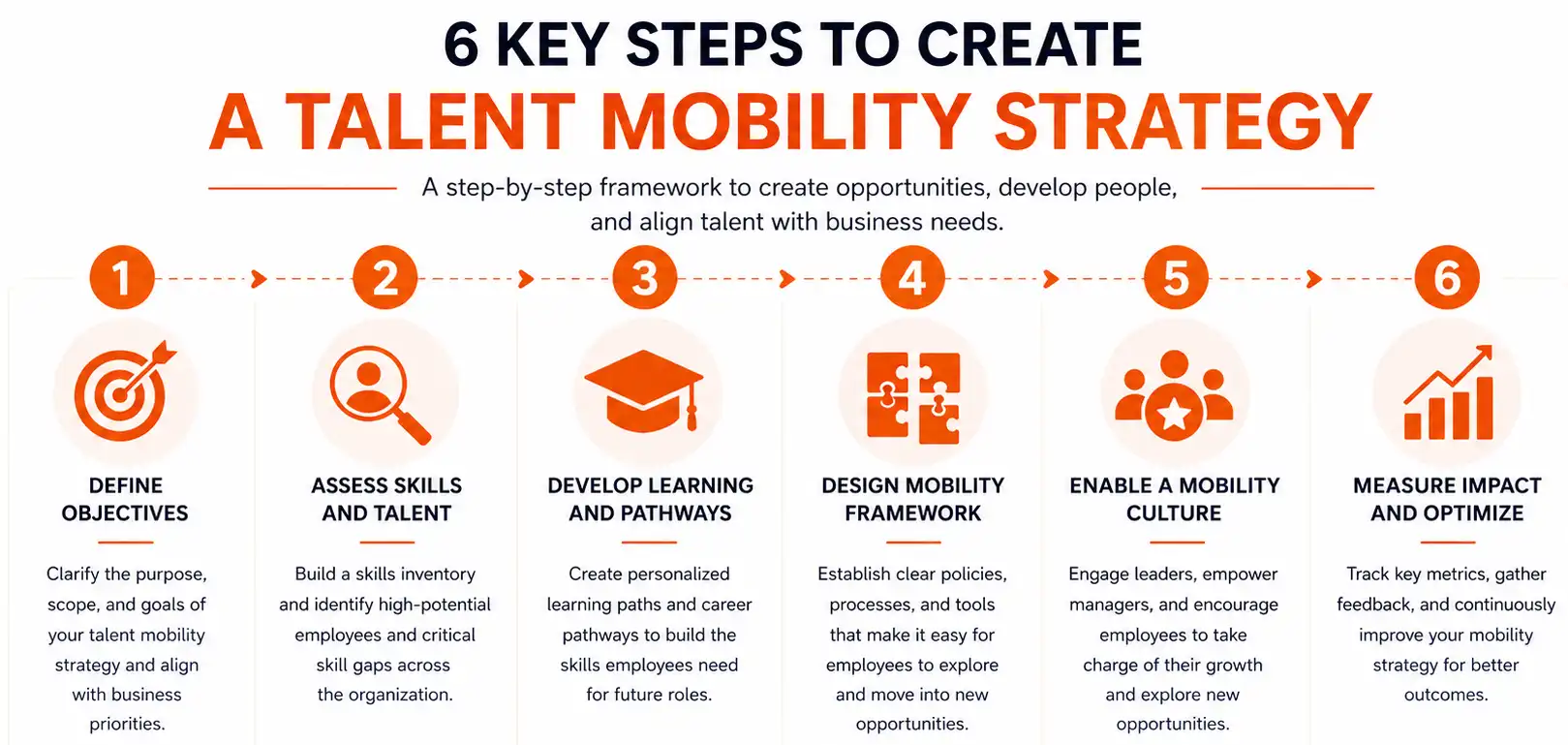
1. Define Organizational Objectives
Start by clarifying the organization's strategic priorities. Whether it's entering new markets, expanding product lines, or adopting new technologies, each objective requires specific skills and roles. By identifying these early, you can anticipate workforce needs and build internal pipelines accordingly.
Solutions like iMocha assist by providing real-time insights into workforce readiness, helping organizations align internal capabilities with future goals.
2. Assess Current Workforce Skills
Conduct a thorough evaluation of employee skills, strengths, and career goals. Leverage skills assessments, performance reviews, and feedback tools to gather data. This process helps identify both high-potential talent and skill gaps across roles and teams.
Here is when implementation of skills ontology tools by organizations help them comprehend the current workforce and enable better decisions about who can transition into key roles and who requires upskilling.
3. Develop Learning and Development Programs
Design personalized upskilling and reskilling plans based on skill gap analysis. Focus areas may include leadership development, technical competencies, or cross-functional collaboration. Use proficiency benchmarks to guide each employee’s progression.
iMocha supports this process with AI-powered assessments and customized learning pathways tailored to role requirements and organizational objectives.
4. Implement a Structured Mobility Framework
Establish formal internal mobility processes that define how employees can move across functions or roles. Outline criteria for eligibility, application workflows, and promotion readiness.
Make mobility accessible by setting up internal job boards, mentorship tracks, and transparent policies that encourage participation. Managers should be trained to support employee transitions and guide career development conversations.
5. Build a Culture of Internal Mobility
Foster an organizational culture that values growth from within. Communicate the availability of internal opportunities through consistent internal messaging and encourage leaders to support internal moves.
Recognizing employees who have successfully transitioned can increase visibility and normalize mobility as a path to advancement.
6. Measure and Optimize
Monitor the outcomes of your mobility strategy through metrics such as internal fill rates, retention of internal hires, time-to-productivity, and employee engagement. Regularly collect feedback from both employees and managers to identify bottlenecks or areas for improvement.
Use this feedback to iterate and refine your strategy. Tools like iMocha offer advanced analytics that help organizations quantify the impact of internal mobility efforts.
Also, explore internal mobility best practices to create career development opportunities and improve talent retention.
Benefits of Talent Mobility Strategy
A well-designed talent mobility strategy delivers long-term advantages for both organizations and employees. Here are the key benefits:
1. Retaining Top Talent
Internal mobility offers employees defined career paths, leading to higher engagement and lower turnover. It supports long-term retention by enabling professional growth within the organization. Companies that invest in mobility also preserve institutional knowledge, strengthening culture and continuity.
Employees at companies with high internal mobility stay 60% longer, highlighting its direct impact on retention and workforce stability.
2. Enhanced Employee Development
By taking on new roles and responsibilities, employees expand their skill sets and gain cross-functional experience. This accelerates their professional development and increases overall workforce adaptability.
3. Better Succession Planning
Talent mobility allows organizations to identify, develop, and prepare high-potential employees for leadership and mission-critical roles. It reduces the risk of sudden vacancies and builds a strong internal leadership pipeline across departments and functions.
4. Reduced Hiring Costs
Filling roles internally minimizes the need for external recruitment. It lowers sourcing, onboarding, and training expenses while reducing time-to-fill. Internally mobilized employees are also more productive faster due to their existing knowledge of company processes and culture.
5. Promotes a Learning Culture
Mobility encourages employees to continuously upskill, adapt to new challenges, and share knowledge across teams. This fosters a learning-oriented environment that supports innovation and long-term organizational resilience.
Check out the top 10 internal mobility platforms to improve employee engagement and drive effective talent development.
Common Talent Mobility Challenges
While talent mobility can improve retention and workforce agility, organizations often face barriers during implementation.
1. Limited Skills Visibility
Many organizations lack a clear view of employee skills, proficiency levels, and career interests. Without accurate skills data, it becomes difficult to match employees to the right opportunities.
2. Talent Hoarding
Managers may hesitate to let high-performing employees move to other teams, choosing instead to retain them within their own teams. This limits internal mobility and restricts employee career growth.
3. Unclear Career Pathways
Employees may not know what roles are available internally or what skills they need to develop to move into those roles. This lack of clarity reduces participation in mobility programs.
4. Rigid Organizational Structures
Traditional hierarchical structures can limit how employees move across roles, teams, or projects. This makes it difficult to enable flexible, skills-based mobility within the organization.
5. Lack of Measurement
Many organizations do not track the effectiveness of their talent mobility initiatives. Without clear metrics, it becomes difficult to evaluate success or improve mobility strategies over time.
To overcome these challenges, organizations should build a centralized skills inventory, define transparent mobility policies, train managers to support internal movement, and use analytics to track progress.
Conclusion
An effective talent mobility strategy helps organizations retain top talent, reduce hiring costs, and build a future-ready workforce. Yet many companies struggle with fragmented data, unclear growth paths, and widening skill gaps. iMocha addresses these challenges through its AI-powered Skills Intelligence platform.
It enables organizations to assess employee capabilities, uncover skill adjacencies, personalize learning, and track development. By aligning internal talent with evolving business needs, iMocha helps companies drive mobility, reduce external hiring dependency, and strengthen workforce agility.
FAQs
What is the talent mobility model?
A talent mobility model is a structured approach that defines how employees move within an organization. It includes guidelines for internal transfers, role changes, and career progression. The model is designed to align workforce capabilities with business needs while enabling employee growth.
What is the talent mobility program?
A talent mobility program is an organized set of initiatives that support internal movement of employees. It typically involves skill assessments, career development plans, role matching, and manager involvement. These programs aim to improve retention, close skill gaps, and strengthen leadership pipelines.
What tools can support talent mobility?
Talent mobility is supported by tools such as skills assessment platforms, Skills Intelligence systems, learning management systems, and performance review tools. These tools help organizations assess employee capabilities, identify opportunities for internal movement, and guide upskilling.
What metrics should be used to measure talent mobility?
Key metrics include internal fill rate, employee retention rate, time-to-fill, skill gap reduction, and employee engagement scores. These help evaluate the effectiveness of mobility programs.
.avif)
.webp)

.jpg)
.webp)


